Most people would rather watch a cockroach drown or kill it with fire, but a team of scientists from the School of Mechanical and Aerospace Engineering at Nanyang Technological University in Singapore has been working hard to keep Madagascar hissing cockroaches breathing underwater for as long as possible.
Professor Hirotaka Sato and his team originally demonstrated that Madagascar hissing cockroaches could be remotely controlled by installing electrodes on their sensory organs. This turned them into drones that could be used in a variety of scenarios, like scouring disaster zones for survivors. There was only one problem – the bugs didn’t handle water well at all, which limited their usefulness in flooded areas.
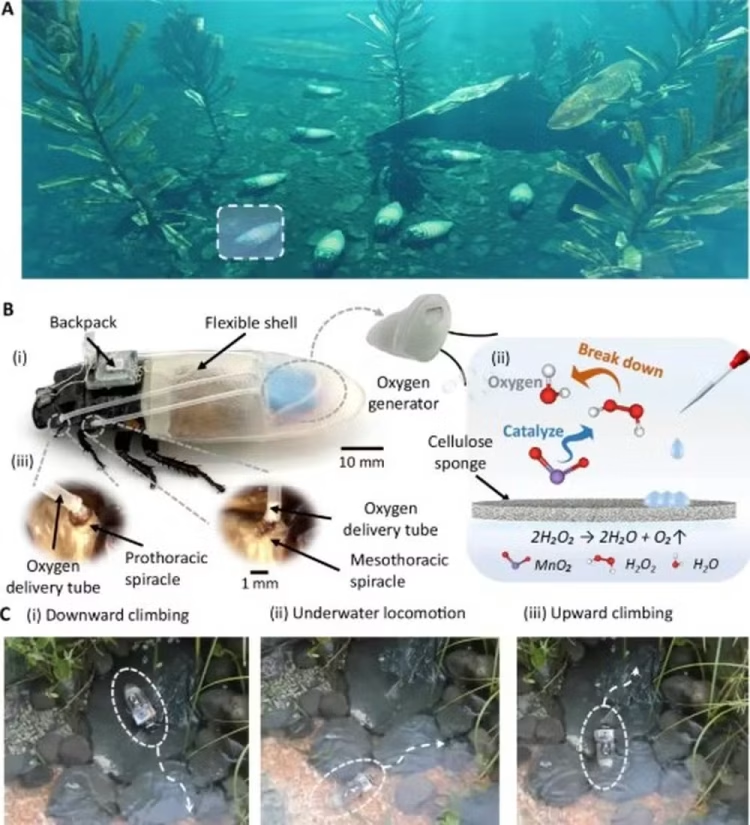
Photo: Hirotaka Sato et al.
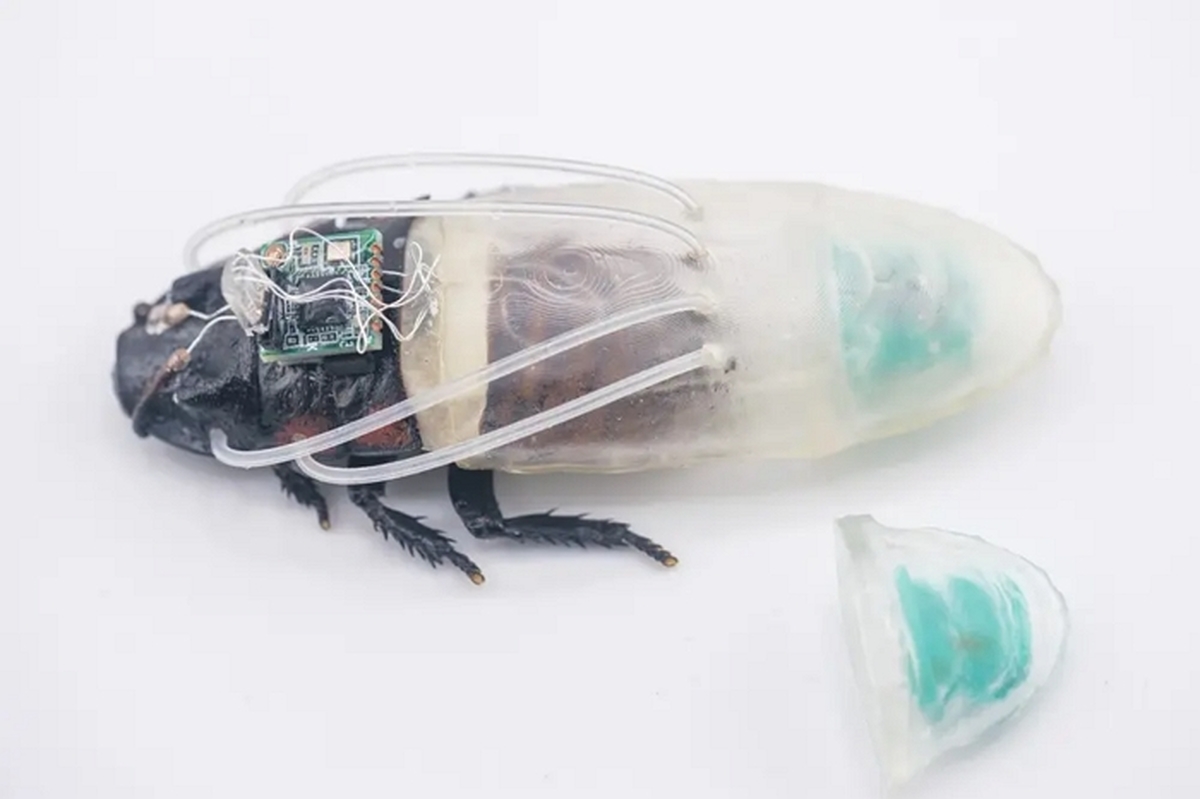
To overcome the cockroach’s natural limitation, researchers started working on a 3D-printed diving suit that could provide the wearer with breathable air for an extended period of time. They came up with a resin diving suit that generates oxygen and supplies it to the cockroach’s spiracles, allowing it to operate underwater for up to three hours.
The diving suit developed by Hato and his team doesn’t come with a conventional oxygen tank; it features a mix of hydrogen peroxide and manganese dioxide, which react to produce absorbable oxygen. The diving suit worked flawlessly in tests, allowing cockroaches to move underwater at speeds of up to 78.4 millimeters per second, only 10 mm less than their average speed on land.
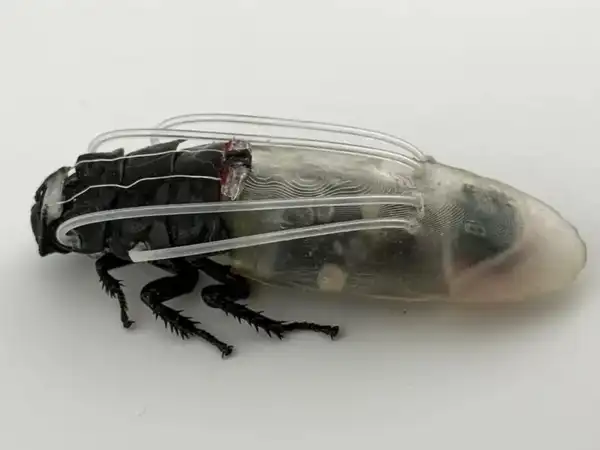
Photo: Hirotaka Sato et al.
“By expanding the operational parameters of our cyborg insects to include underwater movement, we believe they can enhance search and rescue operations,” Hirotaka Sato wrote in a paper he and his team recently published in the journal “Nature Communications“.
The cyborg insect developed by Professor Sato’s team played an active role in ‘Operation Lionheart,’ an actual search and rescue operation during the magnitude 7.7 earthquake that struck Myanmar in the spring of 2025, but the team has more ambitious goals in mind. They dream of using their diving-suit-wearing bugs to one day help explore the surface of Mars.