
An almost transparent animal in the deep ocean can produce a chain of its own clones. Researchers think the glass salp may then keep that chain attached, swimming with the copies trailing behind it like a living train.
The linked animals are part of the salp’s reproductive cycle, giving this delicate drifter a way to turn one solitary individual into a connected group.
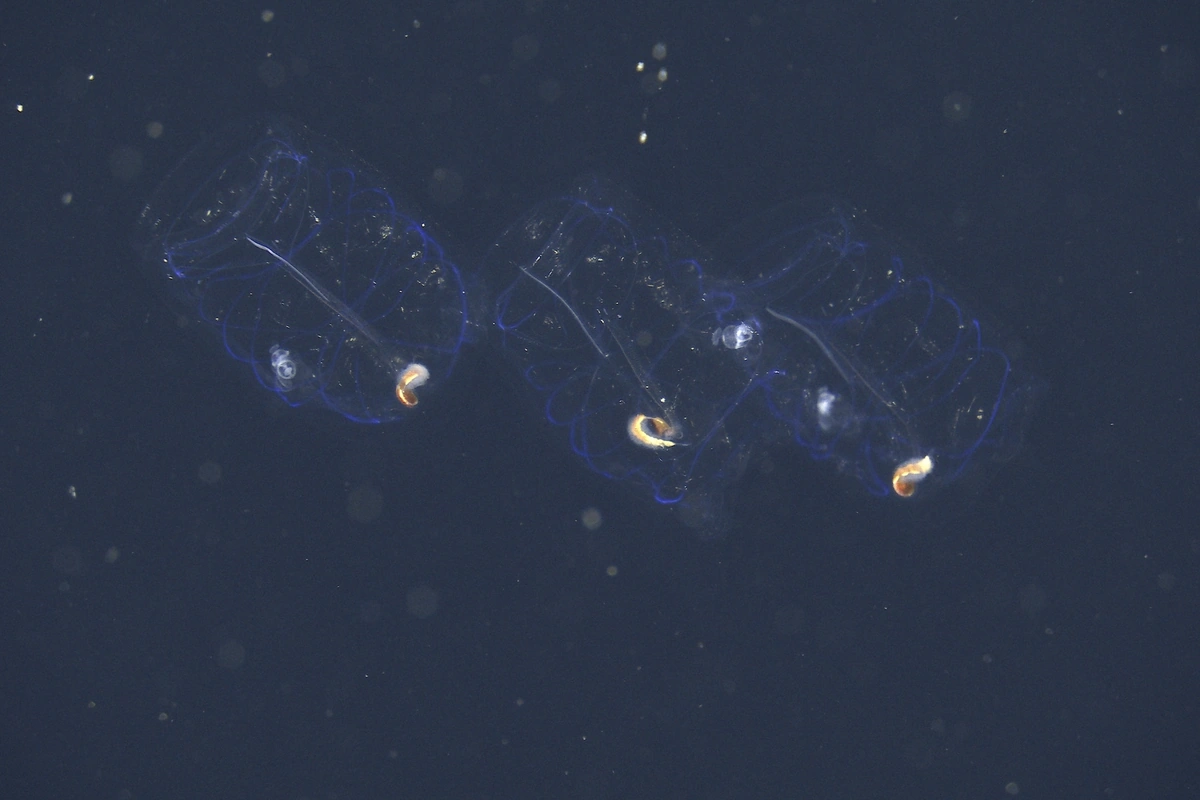
The links in the chain are separate animals
The species is called Vitreosalpa gemini. Salps are gelatinous, barrel-shaped animals that live in open water, and their life cycle alternates between solitary individuals and groups connected in chains.
The solitary stage reproduces asexually, producing a chain of clones. The chain members then reproduce sexually, producing the next generation of solitary salps. Cloning and chain formation are established parts of salp biology.
Researchers have observed chains containing as many as 20 glass salps. That is the largest chain mentioned in MBARI’s announcement, rather than a fixed number every individual produces.
The parent appears to keep its clones in tow
The apparent attachment to the parent makes the scene particularly striking. In MBARI’s account of the species, solitary glass salps appear to produce chains continuously and keep them attached, towing them behind the parent.
The towing remains an observation described cautiously by the researchers. It gives the linked animals the appearance of a convoy following the individual that produced them.
Scientists watched it for decades before giving it a formal name
Researchers first noticed the unfamiliar salp in Monterey Bay more than 20 years ago. Laurence P. Madin’s formal description of the new genus and species was published on September 17, 2026, followed by MBARI’s public announcement on November 24.
The glass salp has been recorded at depths of 280 to 2,200 meters. The study describes it as apparently restricted to deep water, where its fragile body makes underwater observation especially valuable.
Its scientific name reflects two features: the glass-like transparency of its body and the presence of twin embryos. Even its name contains another detail of the unusual reproductive life behind that drifting chain.