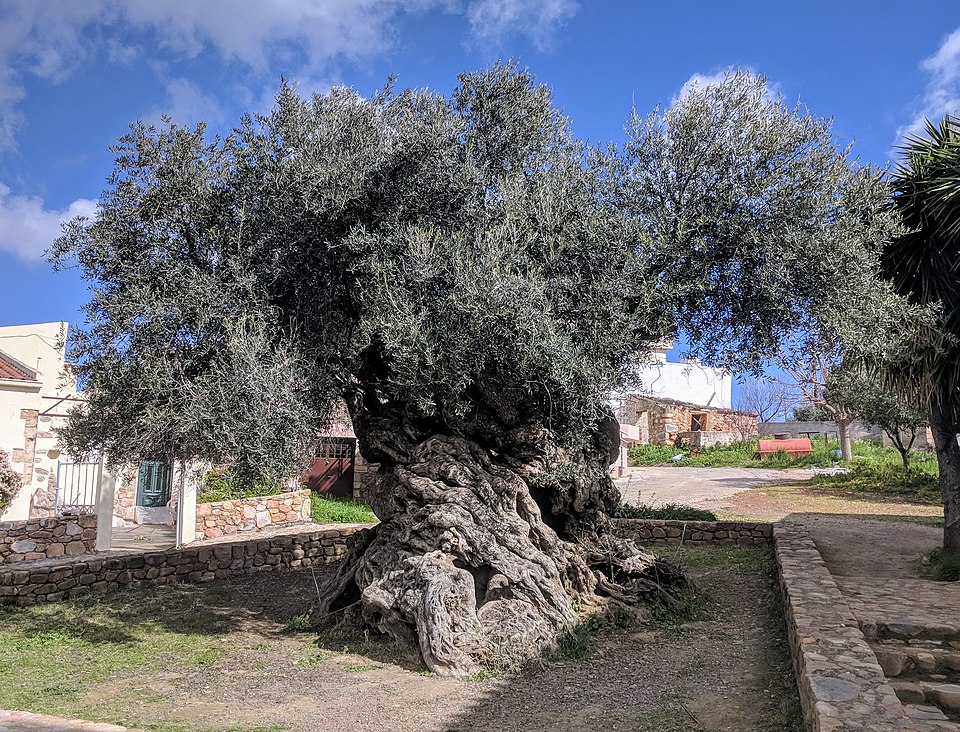
The ancient olive tree of Vouves belongs to the local tree variety of tsounati and was grafted at a height of three meters onto a wild olive tree. Its massive trunk, which has a circumference of 12.5 meters (41 feet) and a diameter of 4.6 meters (15 feet), looks like an intricate structure, but what’s really intriguing is that this natural sculpture is ever-changing.
The exact age of the olive tree of Vouves cannot be determined because its heartwood rotted away centuries ago. This is part of the tree’s remarkable self-renewal process. As the center of the tree continues to rot, new wood is added on the outside, so the design and dimensions of the trunk continue to change, even after thousands of years.
Tree ring analysis has shown the tree to be at least 2,000 years old, but scientists at the University of Crete estimate the tree to be around 4,000 years old. Interestingly, there is no scientific method to ascertain the age of olive trees, so we can’t know for sure how old the Vouves olive tree really is, but it is regarded as the world’s oldest olive tree.
The olive tree of Vouves attracts around 20,000 visitors a year to western Crete and is a protected natural monument.
For reference, the world’s oldest olive tree is older than the Parthenon, another cultural symbol of Greece, and likely predates historical figures like Alexander the Great and Pythagoras. Its whitered trunk is a testament to its resilience, having withstood drought, fires, and human encroachment, while remaining fruitful.
While you’re here, check out the world’s oldest grapevine, which has been around for 400 years.