Scientists at China’s Zhejiang University have developed a new type of thin, transparent glass that can clean itself with the help of built-in electrodes that create an electric field.
Surface particle pollution has long been a problem that science has struggled to solve. From dirty windows in inaccessible places to photovoltaic panels in the middle of the desert, dealing with dust, sand, and other particles is often difficult, time-consuming, and expensive. But what if glass surfaces could simply clean themselves regularly? It sounds like the kind of technology you’d expect to see in a sci-fi blockbuster, but a team of researchers in China claims to have invented a type of self-cleaning glass that can remove up to 98% of surface particles in just a few seconds, without the use of water and chemicals.

Photo: Unsplash
The researchers found that charged particles behave in unexpected ways when exposed to an alternating electric field. Contrary to popular expectation, the dust particles did not simply move sideways, but changed direction or even bounced off the surface entirely. Based on this discovery, they developed a transparent self-cleaning glass driven by the electric field, with a thickness of just 0.62 mm.
According to a study published last month in the Advanced Science journal, the new glass can effectively remove both organic and inorganic particles without any manual intervention. The fact that it is transparent, with high visible light transmittance, makes it ideal for applications where visibility and energy efficiency are essential, such as solar panels, vehicle windshields, greenhouses, and high-rise buildings.
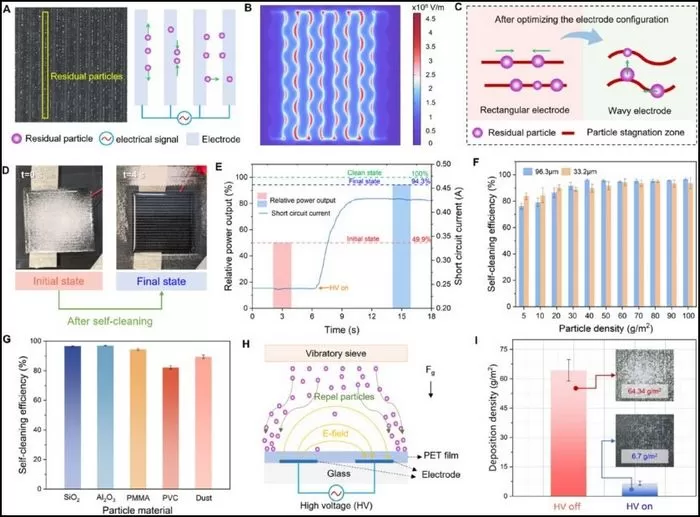
Photo: Advanced Science
And as if the self-cleaning properties of this new type of electric field-powered glass weren’t enough, its inventors claim that it can prevent new particle build-up as well. When the electric field is turned on, charged particles in the air are repelled from the glass surface, an effect that is said to reduce dust accumulation by up to 90%, a phenomenon dubbed “particle shielding effect”. This shielding reportedly works in extreme conditions like sandstorms or extremely dusty environments.
Because it requires common materials and simple production methods, this new discovery is expected to cut the costs and risks associated with cleaning glass surfaces in inaccessible locations and increase the efficiency of solar panels.