The African Hairy Frog has a peculiar self-destructive ability that allows it to snap its toe bones when threatened to create bone claws that pierce its skin just like Marvel’s Wolverine.
Trichobatrachus robustus, aka the Hairy Frog or the Wolverine Frog, is one of nature’s strangest creatures. The males grow thin, hair-like skin threads on the sides of their bodies and their hind legs, a unique ability that scientists believe helps the amphibians absorb more oxygen. These “hairs” contain arteries and are thought to increase the surface area for the purpose of absorbing oxygen when the male guards the eggs in the water. But this is not the weirdest thing about hairy frogs. They also have an unusual self-defense mechanism that allows them to snap their toe bones and turn them into sharp claws that pierce their skin.
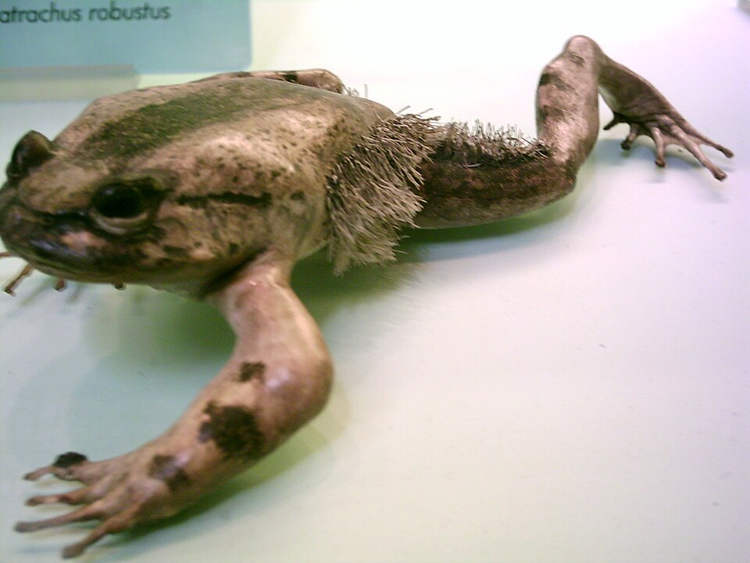
Photo: Gustavocarra/Wikimedia Commons
It was around the early 1900s that scientists first noticed that hairy frogs had claws, an extremely rare characteristic for amphibians. It wasn’t until the early 2000s that researchers discovered that these weren’t actual claws made of keratin, but deformed bones. Cameroonian hunters were quite familiar with the hairy frogs’ sharp weapons and resorted to using spears or machetes to avoid being injured while trying to capture them. A 2008 paper citing earlier reports noted that the frog’s claws can inflict “deep, bleeding wounds visible to the bone” on predators and human captors.
The mechanism that allows the wolverine frog to activate its sharp claws is considered unique in the animal world. Scientists found that each bony claw is anchored to a nodule nestled in the tissue just beyond the frog’s fingertip with tough strands of collagen. When attacked or grabbed, the frog is somehow able to break the nodule connection, forcing the bones through the skin. It then violently scratches at its assailant, causing deep lacerations.
Although a clear retraction mechanism has not been observed, some scientists hypothesize that the hairy frog’s claws later retract passively, as the broken connective tissue regenerates. It is the amphibians’ well-documented regenerative properties that make this unusual self-defense mechanism work without causing any serious harm to the frog.
Trichobatrachus robustus is native to Central African countries like Cameroon, Congo, Nigeria, Gabon, Angola, and Equatorial Guinea, where it inhabits fast-flowing rivers in forests and agricultural land.