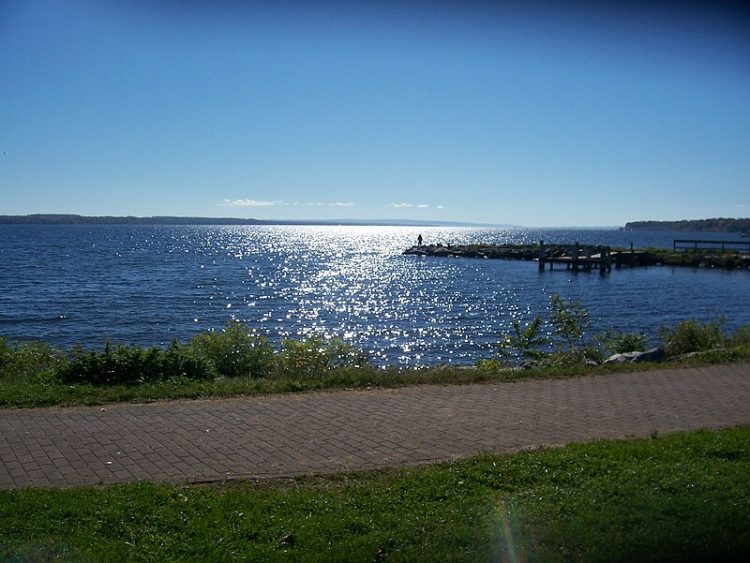
For centuries, scientists have been puzzled by the mysterious phenomenon known as “Seneca’s Gun”, a loud boom emanating from New York’s Seneca Lake.
Records of loud explosions heard on Seneca Lake date back to the 17th century, but they had become the subject of myth and folklore long before that. The Seneca people, a Native American tribe that lived around the lake, believed the booms to be the voice of a god angry at the warriors who had defiled their sacred hunting grounds, while early pioneers believed them to be drums being played by the spirits of soldiers who lost their lives in the War for Independence. It wasn’t until the 20th century that scientific hypotheses started emerging, but none of them were confirmed until 2025, when a team of researchers using advanced equipment mapped the bottom of Seneca Lake.
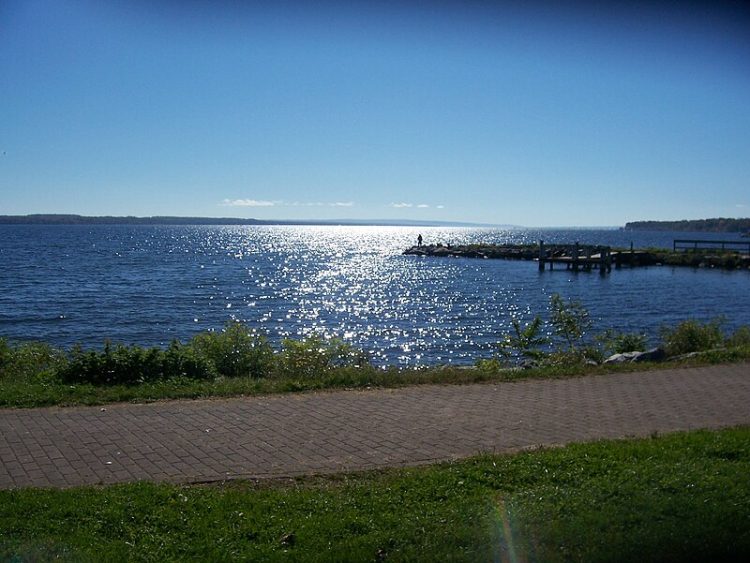
Photo: Scieri12/Wikipedia
For a very long period of time, the booms of Seneca Lake, also known as the “Seneca Guns” or “Seneca Drums,” were a mystery that no law of nature could explain. But in 1934, German geologist Herman Fairchild proposed the “subterranean gas eruption hypothesis,” which suggested that methane gas trapped underground erupted through the lake bed, producing an explosive sound when it broke through the water’s surface. It turned out to be a very accurate explanation, but one that could not be proven at the time.
Attempts to find the cause of the loud booms continued throughout the 20th century, with some researchers using sonar measurements of the lake, and others relying on gas detection equipment, but the phenomenon was so random and sudden that no one was able to provide a full explanation. That changed with a field survey operation carried out on Seneca Lake between 2018 and 2024.
The original purpose of the survey expedition was to document in high resolution the wrecks of 19th-century steamships and other ships that lay on the floor of Seneca Lake, but with the help of advanced equipment, they also discovered over 140 “pockmarks”. The diameter of these huge depressions ranged from several tens to several hundred meters. Scientists suspected that the unusual topography on the lakebed was connected to the Seneca Guns phenomenon, but confirmation came earlier this year.
A joint team of scientists from the State University of New York’s School of Environmental Science and Forestry and Cornell University collected water and sediment samples from multiple locations on the lake bottom to analyze them for the presence of geological gases such as methane. After analyzing the data, they finally confirmed the “subsurface gas eruption theory” proposed by Fairchild in 1934.
Apparently, gas builds up pressure underground over a long period of time, and when it reaches a limit, it breaks through the bottom of the lake and is released all at once. When the giant bubbles rise to the surface and burst, they create a shock wave that produces a low rumbling sound similar to a cannon shot.
Interestingly, the Seneca area is also famous for the world’s largest herd of white deer.