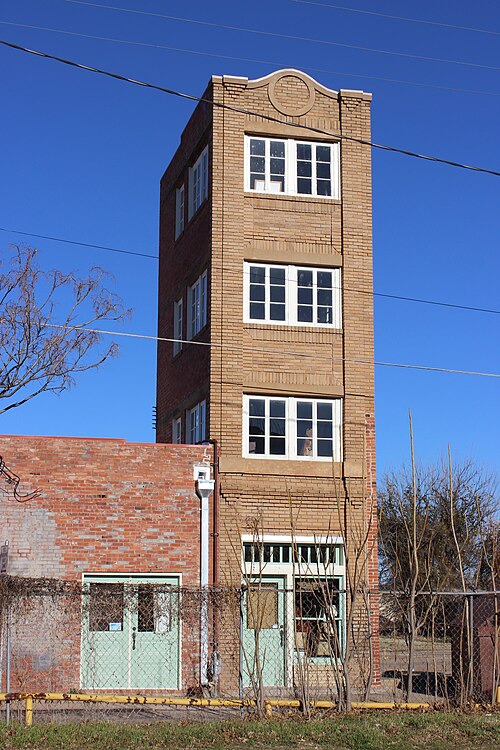
At just 40 feet tall, the Newby-McMahon Building in Wichita Falls isn’t very impressive, even when compared to regular-sized buildings, let alone skyscrapers. And yet it was supposed to be one of the most imposing skyscrapers of its time when it was designed in the early 1900s.
The nickname ‘World’s Littlest Skyscraper’ is a dubious title to have, but the Newby-McMahon Building is indeed dwarfed by every skyscraper in the world. It isn’t remotely worthy of being called a skyscraper, as it’s dwarfed by several normal buildings in Wichita Falls, but the story of how it came to be is truly fascinating.
The origins of the Newby-McMahon Building can be traced back to the early 1900s, when the North Texas city of Wichita Falls became the center of a regional oil boom. The discovery of black gold in nearby Burkburnett turned hundreds of locals into millionaires, as mineral rights were negotiated virtually everywhere, from street corners to temporary tents.
Philadelphia oil man J.D.D. McMahon was the first to notice the city’s dire need for office space and quickly proposed a solution – building an imposing skyscraper right next to the original Newby Building, built by Augustus Newby in 1906. His blueprints caught the eye of several investors, and he was able to raise about $200,000 (about $6.8 million in today’s money).
McMahon promised a multistory office building that would be built just across the street from the St. James Hotel, but what he failed to mention was that it wouldn’t go up very much. Exctatic investors didn’t notice that the building’s scale was measured in inches rather than feet, and, by the time they realized they had been scammed, it was too late.
The architect of this ingenious scam used his own crew to conduct the construction, and by the time his plan was revealed, he was long gone. Investors tried suing to get their money back, but because the plans for the world’s smallest skyscraper clearly said 480 inches, not feet, the judge dismissed their attempt, faulting them for not paying more attention.
To make the whole situation even more embarrassing, the company in charge of installing the elevator pulled out of the project upon learning about its true size, so the only way to reach the upper floors was on an external ladder. An internal staircase was built later, but because the diminutive skyscraper measured just 11 feet by 19 feet, it ended up taking about 25 percent of the space.
Not long after the completion of the world’s smallest skyscraper in 1919, the oil boom ended, and the Great Depression began. The building fell into disrepair, and even after the American economy rebounded, it only briefly attracted tenants. There were times when local officials considered demolishing it, but locals fought to save it, and it was eventually included in the National Historic Register.
Once an embarrassment for Wichita Falls, the world’s smallest skyscraper is now one of its main tourist attractions.