An empty milk carton usually has one last journey to make: the trip to the recycling bin. In a Berlin workshop, discarded drink cartons have become the moving parts of a working clock. They form the gears that turn its hands, and the finished mechanism runs for a little over an hour after winding.
The project belongs to artist and inventor Niklas Roy, who calls it Carton Clock. Milk and juice packaging provided his building material, with the printed labels and shiny inner surfaces still visible throughout the assembly.
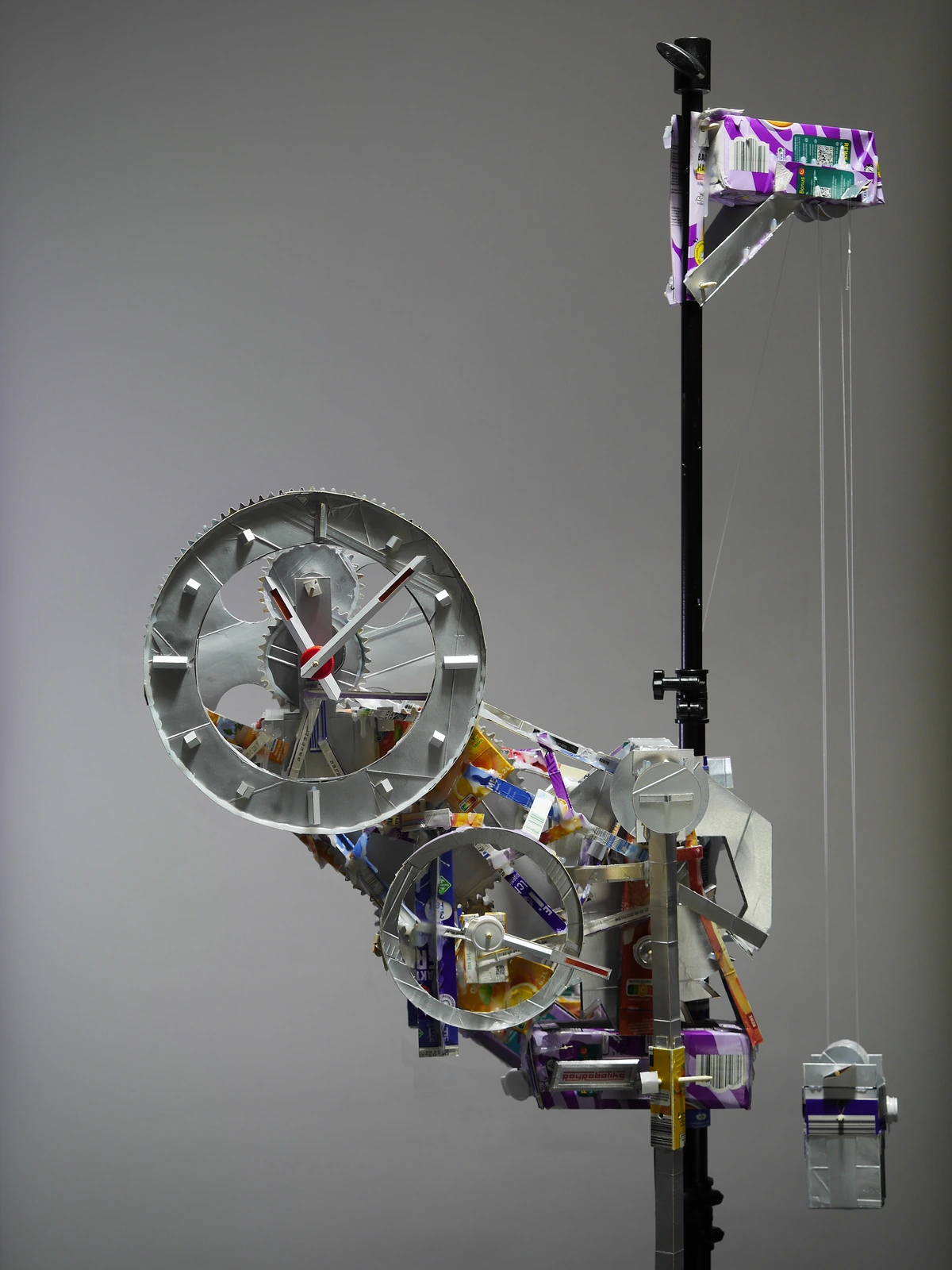
The packaging does the mechanical work
Cartons can provide a decorative case for an ordinary clock mechanism. Roy gave them a much harder job: the cartons themselves became the gears. Their teeth have to engage with neighboring wheels and pass motion through the clockwork.
The packaging also has a useful property hidden in its familiar construction. Its cardboard provides stiffness, while a thin polyethylene coating gives contacting surfaces a relatively slippery finish. That helps the moving parts slide against one another with less friction.
The material comes with a drawback, too. Hot glue does not readily stick to that coating, so holding the assembly together required plenty of adhesive.
Roy also used paper straws, barbecue skewers, string and metal nuts. The result is a working assembly made with discarded drink packaging and a small collection of other materials.
The first version ran for 7.5 minutes
Roy had already built a different project, the Glashütte Trash Clock, before attempting this one. Back in Berlin, he wanted to see how much of another functioning clock he could make from an empty milk carton.
His first Carton Clock was a proof of concept with a seconds hand. It ran for just 7.5 minutes, enough to show that the material could support a working mechanism, but short of the running time he wanted.
Version two expanded the task. It needed the gear stages for seconds, minutes and hours, along with enough stored energy to keep the mechanism moving for at least an hour.
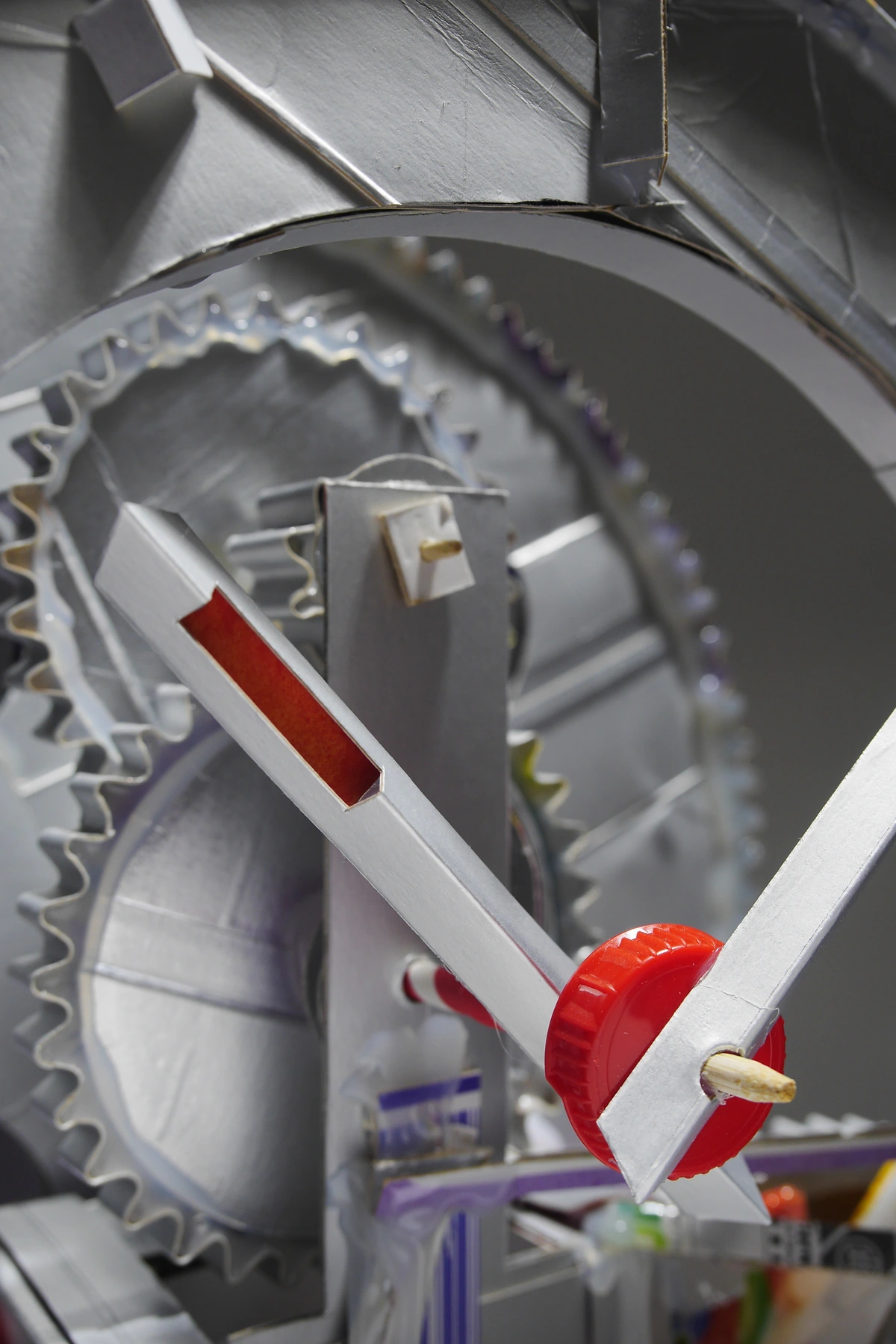
Modern tools helped the cartons become gears
Making the parts involved more than scissors and guesswork. Roy used browser tools, developed with AI assistance, to work out components and produce cutting templates. He also used 3D-printed jigs to help assemble the carton pieces.
Those printed tools stayed outside the clock. They helped make the parts; they did not become parts of its running mechanism.
The completed second version met the running-time goal, continuing for a little over an hour when fully wound. It still has a limitation: Roy says it runs slightly fast. His next-clock wish list includes “long running time and high accuracy”.
For now, the achievement is visible in every turning wheel. The familiar packaging has kept its supermarket colors while taking on a demanding new task: moving the hands of a clock.