A Mexican hairy dwarf porcupine can blend into the branches under ordinary light, then look strikingly different beneath a UV flashlight. Researchers found blue-green light coming from its quills and bright yellow from the soles of its feet, revealing colors that are normally hidden from view.
The change appeared in every live adult they examined. It also gave the team a possible way to find these nocturnal, tree-dwelling animals among leaves and branches.
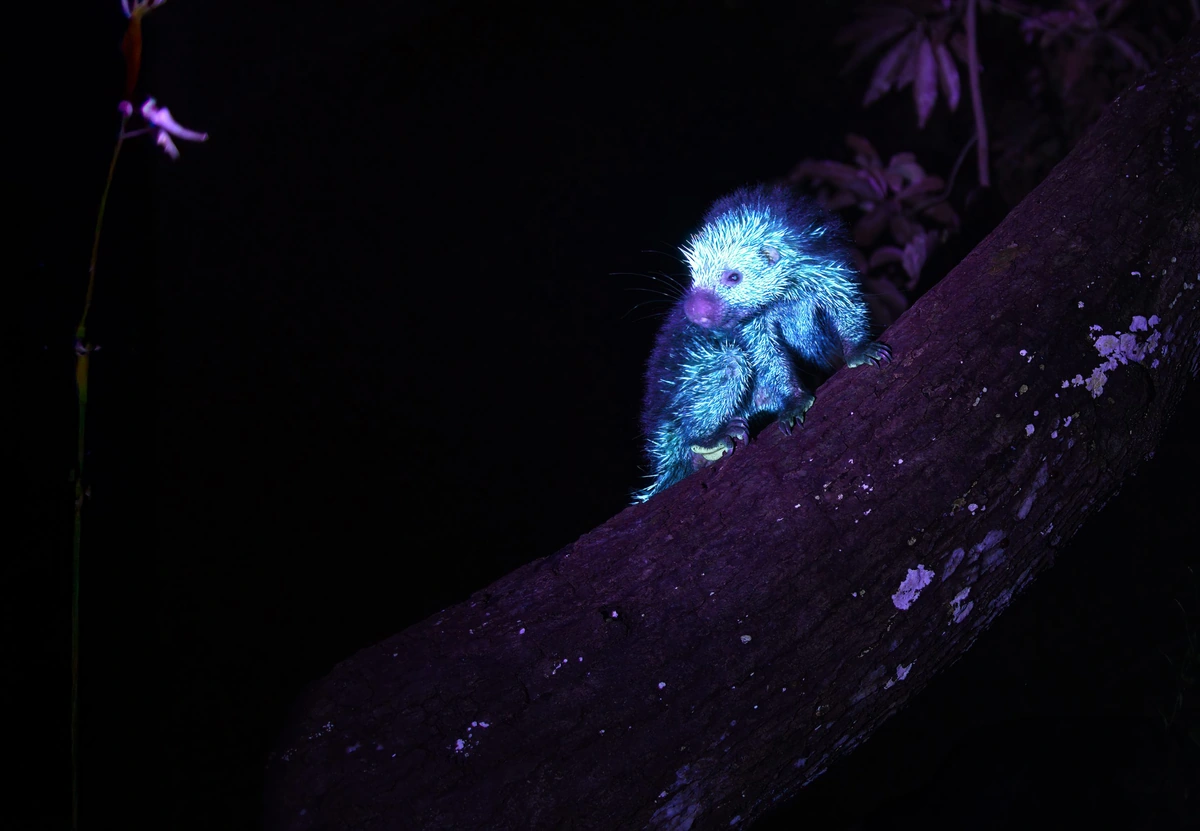
All 20 adults examined showed the effect
The animals belong to Coendou mexicanus, the Mexican hairy dwarf porcupine. Researchers at El Colegio de la Frontera Sur, or ECOSUR, documented the effect in Chetumal, in Mexico’s Quintana Roo state.
Jonathan Pérez-Flores first noticed it in June 2024 while two females were receiving clinical evaluations. He was using a portable flashlight producing ultraviolet light at a wavelength of 395 nanometers.
Over the following three months, the team examined 20 live adults, including 17 females and three males. Every one showed photoluminescence.
The head produced the strongest effect. The back, limbs and tail appeared greenish-blue. On freshly collected quills, the sections that looked yellow in visible light glowed green under UV, while the brown tips appeared blue. The bright yellow was visible on the soles, rather than across the animals’ entire feet.
The colors require ultraviolet light
The porcupines are responding to an outside light source. Their tissues absorb shorter-wavelength light and release it at longer wavelengths, producing the colors recorded by the researchers.
They do not produce their own light in the dark. This is photoluminescence, rather than bioluminescence, the light-making process associated with animals such as fireflies.
The observation concerns a known species, and photoluminescence has already been recorded in other mammals. What remains uncertain is what, if anything, these colors do for the porcupines themselves. A possible role in communication is a question for further research.
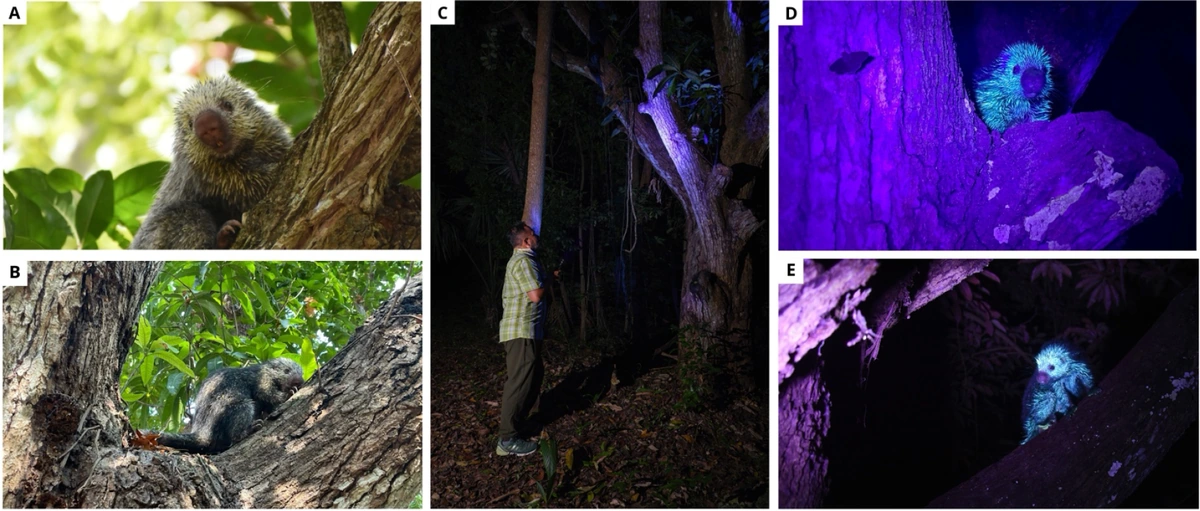
A flashlight could help locate porcupines in trees
The team also took the flashlight outside. Between July and December 2024, researchers completed 12 nighttime walks along a one-kilometer route on ECOSUR’s grounds, searching at ten observation points.
They recorded 20 porcupine detections. That count represents sightings, so it does not establish that they found 20 different animals.
Under UV light, the quills and soles stood out against the surrounding vegetation. That could make the method useful for monitoring an animal that spends its nights above the ground, although the work does not establish that UV searches outperform other survey methods.
For now, the practical result is a new way to make a difficult-to-see animal stand out. The porcupine stays in the tree; changing the light reveals a different set of colors.