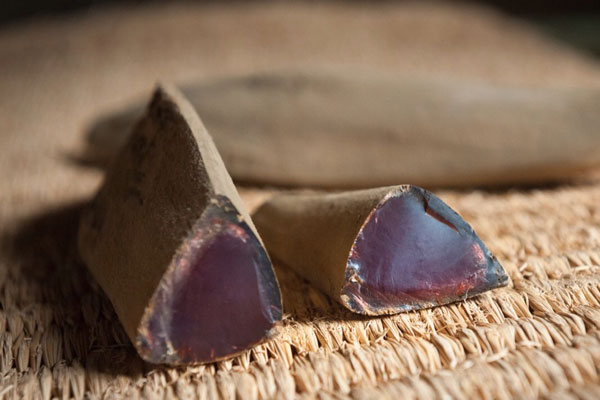
Katsuobushi is a Japanese traditional food product created by putting skipjack tuna through a long and complex manufacturing process that includes fermentation and maturation. The end result is a piece of dried fish with a moisture content of around 18 percent that is rock-hard and shines like a jewel.
The history of fermented katsuobushi can be traced back to the Edo period (1603 – 1868), although mentions of “fish that has been boiled and dried hard” can be found in the Yoro Code of 718. It remains an essential ingredient for the dashi stock used to make popular dishes like miso soup and soba dipping sauce.
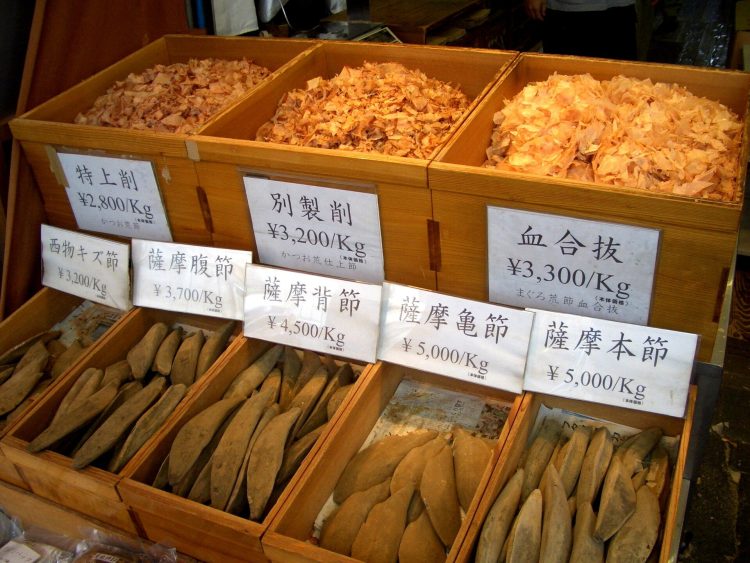
Photo: Adriano/Wikimedia Commons
The complex process of making katsuobushi begins with frozen skipjack tuna, aka ‘bonito’. The fish is first thawed in water for 24 hours, then cut into fillets that are placed in a special cauldron and simmered for up to 90 minutes. It is then cooled, deboned, and much of its skin and fat are removed. At this stage of the process, the water content of the bonito is about 68%.
Next, the fillets are placed in wooden-lidded baskets and wood-smoked for about an hour, then allowed to cool. This process is repeated dozens of times, for about a month. The smoke drastically lowers the water content in the fish, draws out excess fat, and also prevents it from rotting. By now, the moisture content has dropped to around 28%.
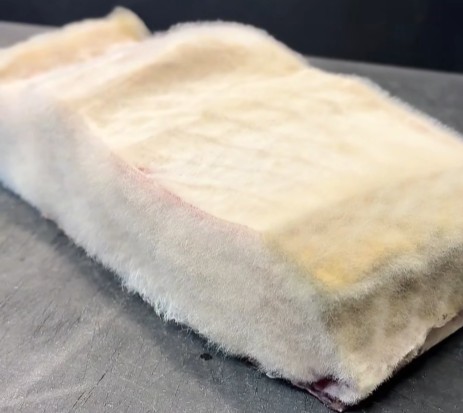
To make the highest grade of katsuobushi, the fillets are sprayed with a solution containing the Aspergillus glaucus bacteria and placed in a special chamber at a temperature of 20 degrees Celcius. After two weeks, the mold-covered fillets are taken out to dry in the sun for two days, after which they are once again sprayed with mold and left to ferment for two weeks. This process is repeated for several months until the moisture in the katsuobushi reaches the desired level of around 18% – 20%.
The mold plays a critical part in the making of katsuobushi, as it consumes moisture to sustain itself, accelerating the drying process, decomposes fat into soluble fatty acids, breaks down proteins into amino acids, and keeps off other microorganisms during the fermentation process.
Fermented katsuobushi is as hard as wood, extremely brittle, and looks like crystal or colored glass when polished. It is shaved into thin flakes using a tool similar to a wood planer.
For the world’s hardest cheese, check out Nepal’s rock-hard chhurpi cheese.